
So convenient a thing to be a reasonable creature, since it enables one to find or make a reason for every thing one has a mind to do. – Benjamin Franklin
For a little bit we will look at just a couple common fallacies that are used on Christians to cause doubt or undermine a biblical truth. Three common ones that will be looked at here are; The Strawman Argument, the Ad Hominem, and the Motte-and-Bailey.
For the first one we will look at the Motte-and-Bailey. It usually goes something like this: “I don’t want to offend anyone by saying I believe the Bible. There is so much confusing or even hurtful stuff in there. I want to just love people.” That thought is a simple type of philosophical argument called a Motte-and-Bailey. A Motte Bailey dates back to old French Medieval times when you had an easily defended position (Motte) filled with the important stuff like wells, blacksmiths and armories. Then surrounded by the less important, and harder to defend surrounding land (Bailey) that would have houses and farms outside the motte walls. Hence the argument being about we as Christians need to be full of love is the motte. Of course we can all agree on that, because it’s biblical. We are to love one another in the church and love our enemies! Next is the bailey; “we don’t need to worry about making issues out of stuff we don’t understand or might be hurtful.” Traditional Christians may get squeamish about the bailey, but when you preface it with something we can all agree on then that pill is easier to swallow. You can easily substitute any biblical truth in the previous framework and still fall under the Motte-and-Bailey Fallacy. We have to beware of the subtle ways the enemy will twist God’s word and give it back to us in ways we might not readily see as dangerous.
Another example of how to use a Motte-and-Bailey is: Why does a loving God send people to Hell? Can you see the Motte? Maybe the Bailey? God doesn’t send anyone to Hell, we make that choice as humans when we reject God, which James 1:13-15 makes very clear. Secondly, the subtle thought is present in that question of; well He doesn’t, so either Hell isn’t real of God is not love. And according to Occum’s Razor we would say there must not be a Hell. It’s important to analyze not only possible motive behind why critics and false teachers say the things they do to Christians, but also making sure we are grounded in the Word to know the truth over the counterfeit.
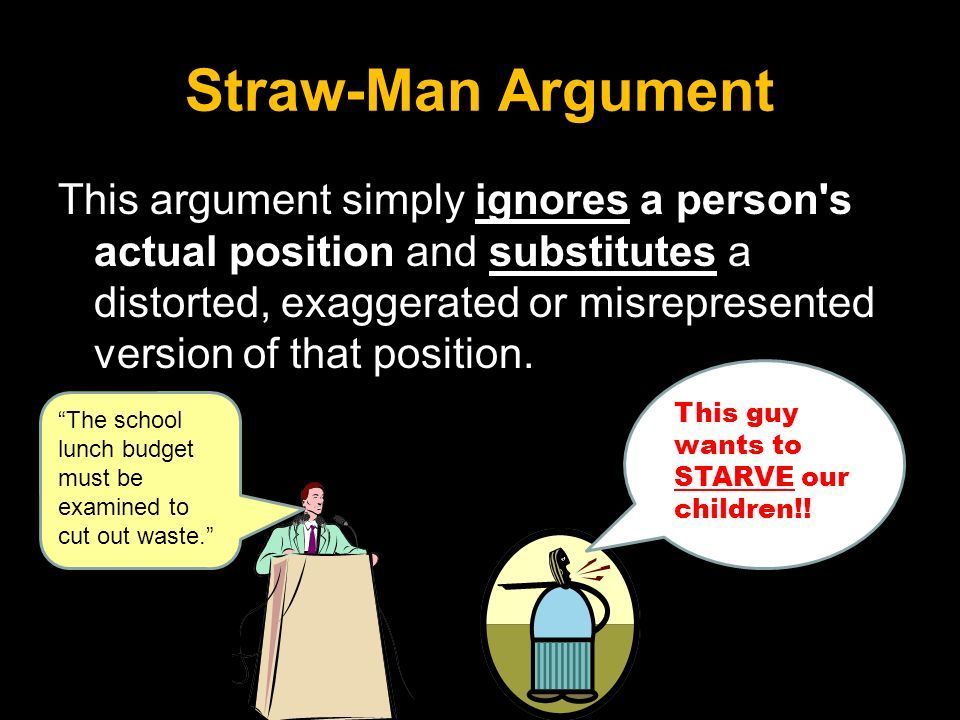
While comical in the picture above, a Strawman Argument can be very frustrating and disillusioning to a Christian when trying to explain a biblical truth to someone dabbling in heresy or falling away from the faith (Galation 6:1 can apply here). While trying to defend a principle in God’s Word, but then having to pivot to something unrelated is what this Logical Fallacy does. It can be applied like this: The abortion argument. As Christians the Bible is very clear on how God values life, especially the lives of children (Gen 1:27, Psalms 139:13-16, Prov. 6:17b among others). However, even in today’s churches there is a growing trend of believers caving to the pressure to murder an unborn child because of pressure from the world. Instead of realizing the truth of the argument we are told we hate women, and want women to die. Causing us to now have to refute an untruth, while being forced to argue something that has nothing or very little to do with valuing the unborn life God has made in a woman. Another topic commonly used in the Strawman category is the issue of homosexuality. Again, we are told we are unloving or hate-filled, instead of understanding the true nature of the issue: God declares in Genesis that a marriage is one man, one woman for life. It is just that simple.
Thirdly is the logical fallacy called an Ad Hominem. Which is basically summed up as attacking the person; not the argument. This is an increasingly popular tactic used by more liberal (more generous term than apostate) aspects of Christianity. An example can be found in the ongoing debate on nonconformity issues like dress, and entertainment. When the subject is brought up of what is appropriate for a Christian to wear or what entertainments are okay, one will find very quickly that it is a very touchy subject! The basis for some kind of line to be drawn is found in Roman’s 12:2 and Philippians 4:8. But, when pointing out areas we shouldn’t be involved in as a Christian, critics will be quick to denigrate you as a person. With words like: “You just want to show off how pious you are” or, “why do you have to be so holier-than-thou?” The fallacy used in a group setting will subconsciously causes doubt in the other hearers in the validity of your argument when a critic is able to put the focus on a perceived failure of the speaker, and not on the merits of the argument being presented. A perfect example of an Ad Hominem in scripture is when The Lord Jesus Christ was preaching to people in Matthew 13:54-58: “And when he was come into his own country, he taught them in their synagogue, insomuch that they were astonished, and said, Whence hath this man this wisdom, and these mighty works? 55. Is not this the carpenter’s son? is not his mother called Mary? and his brethren, James, and Joses, and Simon, and Judas?
56 And his sisters, are they not all with us? Whence then hath this man all these things?
57 And they were offended in him. But Jesus said unto them, A prophet is not without honour, save in his own country, and in his own house.
58 And he did not many mighty works there because of their unbelief.”. In John 15:18 Jesus clearly stated if the world hated Him then certainly it will hate His followers. So don’t let the attacks that come keep us from sharing the truth that needs to be shared.
These fallacies have many forms thst are used by well meaning Christians, and some not so; BUT it doesn’t change the fact that as true Bible believing Christians we have to take what we read and make application, and lovingly show the world (in word and deed) what that looks like. James 1:27 says it this way “Pure religion and undefiled before God and the Father is this, To visit the fatherless and widows in their affliction, and to keep himself unspotted from the world.“. We like the first part, but we sadly balk at how to define the second part. In dealing with these fallacies that are used on Christians it can get messy, but we must never back down from the darts of the wicked but press on in the assurance of the armor we have at our disposal in Ephesians 6!
Winston Churchill summed it up nicely when he spoke at his Alma Mater, Harrow School: “This is the lesson: never give in, never give in, never, never, never, never—in nothing, great or small, large or petty—never give in except to convictions of honour and good sense. Never yield to force; never yield to the apparently overwhelming might of the enemy.” so should the Christian not give in to the fallacies and shouts from the enemy. God bless!
 Jude 3